
Sable Projects
Water-Based Underfloor Heating Installation in London & Home Counties
We design and install water-based underfloor heating systems for refurbishments, extensions, and new builds across London & the Home Counties.
Systems are designed around the build from the outset — not added after key decisions are locked in.
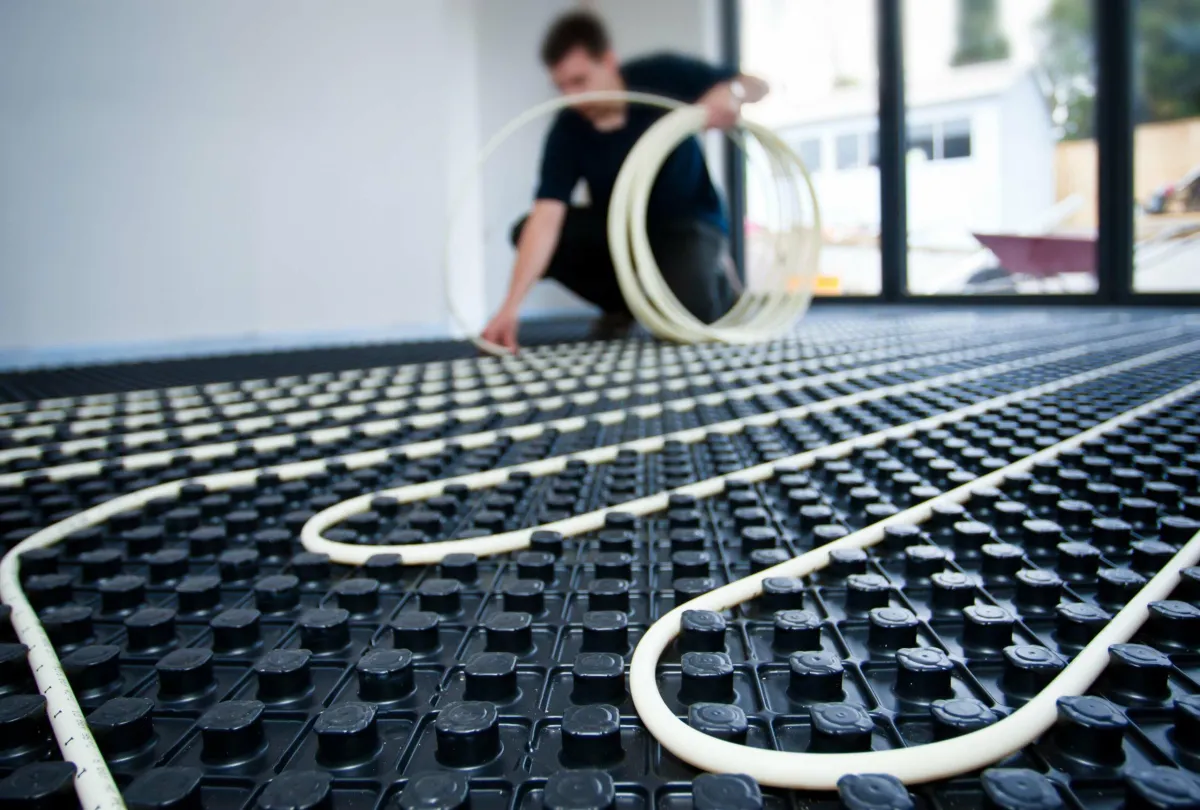
How Water-Based Underfloor Heating Systems Are Planned
Water-based underfloor heating systems need to be designed around the structure of the building — not added once finishes are already decided.
Before any installation, we assess floor build-ups, insulation levels, room layouts, and heat demand. This allows us to confirm whether underfloor heating is suitable for the property and how it should be integrated with the wider heating system.
System planning typically considers:
Floor construction and available build-up depth
Insulation levels and heat-loss requirements
Room usage and zoning needs
Integration with boilers or heat pumps (see our Heat Pumps & Renewables page)
Pipe spacing, loop lengths, and manifold locations
Control strategy and future adjustability
By designing the system in context, we avoid common issues such as insufficient heat output, uneven temperatures, or conflicts with finished floor levels later in the project.
Every underfloor heating system is specified to suit the property — not taken from a standard template.
This ensures underfloor heating works as part of the overall heating system — not as a standalone addition.
For a Detailed Breakdown Sable of Wet Underfloor Heating Cost, See Our UFH 2026 Guide
We install water-based underfloor heating systems on residential projects across London & the Home Counties, working alongside builders and homeowners to ensure systems are designed before first fix — not after.
What You Get With a Sable Underfloor Heating Installation
Clients choose Sable Projects because underfloor heating systems are planned properly before installation — not treated as an add-on.
That means better performance, consistent heat across all zones, and fewer issues during installation. Systems are coordinated with floor build-ups, insulation, and finishes to avoid clashes later in the project.
Installation is coordinated with other trades, tested properly, and delivered without rework or site delays.
For projects where finish, comfort, and long-term reliability matter, this approach makes a measurable difference.
System Design Support for High-Value Projects
On projects where performance matters, system design is just as important as installation.
For underfloor heating systems that require detailed heat-loss calculations, zoning strategies, or integration with low-temperature systems, we work with specialist design partners such as Nu-Heat.
This allows us to validate layouts, confirm outputs, and ensure the system is designed correctly before installation begins. Combined with careful on-site delivery, this approach helps avoid common issues such as underperforming zones or systems that look right on paper but struggle in use.
Our focus remains on delivering underfloor heating systems that perform reliably in real buildings — supported by sound design and professional installation.
Explore our Nu-Heat partnership and approach

For systems designed with Nu-Heat, see our Nu-Heat underfloor heating page
Why Our Work Focuses on Water-Based Underfloor Heating
Underfloor heating systems need to be suited to the scale and demands of the property.
For whole-home heating, extensions, and larger refurbishments, water-based underfloor heating provides consistent output, efficient operation, and straightforward integration with modern heating systems. It allows heat to be distributed evenly across larger areas and can be designed to work alongside boilers or low-temperature heat sources.
Electric underfloor heating can be appropriate for small, isolated areas, but it is rarely suitable as a primary heating system for entire properties.
For this reason, our work focuses on water-based systems that are designed to perform reliably over the long term and support the wider heating strategy of the building.
We install water-based underfloor heating systems across London & the Home Counties as part of full heating system upgrades and refurbishment projects.
Our Underfloor Heating Installation Process
Underfloor heating systems are planned and installed as part of the wider build — not added once decisions are already fixed. Our process ensures the system is designed correctly, installed at the right stage, and performs as intended once the project is complete.
1. Assessment & Floor Review
We review floor construction, insulation levels, layouts, and heat demand to confirm suitability and establish the correct system approach. This includes checking available build-up depths and sequencing with other trades.
2. System Design & Specification
Loop layouts, pipe spacing, zoning, controls, and integration with the wider heating system are specified based on the project requirements. Where required, heat-loss calculations are used to validate outputs before installation begins.
3. Installation & Coordination
Pipework is installed methodically and to specification, coordinated with screeding, flooring, and other trades to avoid clashes or rework. Care is taken to protect finished areas and maintain site standards.
4. Testing, Commissioning & Handover
Before handover, the system is pressure-tested, commissioned, and checked for correct zoning and control operation. Clear guidance is provided so the system can be used and adjusted confidently.
Common Questions About Underfloor Heating
Is water-based underfloor heating suitable for existing homes?
It can be, but suitability depends on floor construction, available build-up depth, and insulation levels. We assess these factors before confirming whether underfloor heating is appropriate for an existing property.
When should underfloor heating be planned during a project?
Underfloor heating should be planned early — ideally before floor levels, insulation, or screeds are finalised. Early planning allows the system to be designed correctly rather than adapted later.
Can water-based underfloor heating work with a boiler?
Yes — water-based underfloor heating can work effectively with most modern gas or system boilers, provided the system is designed correctly from the outset. The key is ensuring flow temperatures, manifold configuration, zoning, and pump capacity are properly specified. Underfloor heating operates at lower temperatures than traditional radiators, so mixing controls or blending valves are often required to regulate output safely. On refurbishment and extension projects across London & the Home Counties, this integration is planned before first fix to ensure plant space, pipe routing, and service access are resolved early — avoiding rework or compatibility issues later in the build.
Can underfloor heating be installed alongside radiators?
Yes. Underfloor heating can be used in combination with radiators where appropriate. Zoning and control strategies are designed to ensure both systems work together efficiently.
How is each room controlled with underfloor heating?
Systems are typically designed with multi-zone controls, allowing different areas of the property to be controlled independently. Control strategies are specified during the design stage.
Is underfloor heating suitable for extensions and new builds?
Yes. Underfloor heating is particularly well suited to extensions and new builds, where floor build-ups and insulation can be designed to support the system from the outset.
Does underfloor heating work with heat pumps?
Yes — water-based underfloor heating pairs particularly well with air-source heat pumps and other low-temperature heating systems. Because underfloor heating distributes warmth evenly across a larger surface area, it operates efficiently at lower flow temperatures, which aligns with how heat pumps perform best. Proper heat-loss calculations, emitter sizing, and zoning strategy are essential to ensure the system delivers consistent output throughout the property. On new builds and major refurbishments, we assess insulation levels, floor construction, and overall heat demand before confirming system suitability, ensuring the heating strategy works as a cohesive whole rather than as a bolt-on upgrade.
Is water-based underfloor heating efficient compared to radiators?
When designed correctly, water-based underfloor heating can operate more efficiently than traditional radiator systems because it runs at lower flow temperatures while distributing heat evenly across the room. This reduces hot and cold spots and allows modern boilers or heat pumps to work within optimal efficiency ranges. Efficiency, however, depends on insulation levels, heat-loss calculations, zoning design, and overall system specification. For this reason, underfloor heating is most effective when planned as part of the wider heating strategy rather than added late in the project. Proper design ensures performance, comfort, and long-term reliability.
How much floor height is required for underfloor heating?
The required floor build-up depends on the type of system specified and the construction of the property. In new builds, underfloor heating is typically integrated within screed or structural floor layers, where sufficient depth can be designed in from the start. On refurbishment projects, floor build-up is reviewed carefully to determine whether a low-profile system is more appropriate. Consideration must be given to insulation, screed thickness, finished floor levels, and door thresholds to avoid conflicts later in the programme. Early assessment ensures the system is viable without compromising structural integrity or final floor finishes.
Ready to Discuss Underfloor Heating?
If you’re planning a refurbishment, extension, or new build, we’re happy to review your project and advise on the most suitable underfloor heating approach.
We work across London and the Home Counties on underfloor heating installations for refurbishments, extensions, and new builds.
Start with a conversation — we’ll assess the build, floor construction, and heating requirements before outlining clear next steps.
No pressure. No rushed decisions. Just clear advice and professional input.

A few details helps us respond properly. If you have drawings or a spec, email them to
Phone: 0207 078 9415
Address Office: 2a Highland Drive, Hemel Hempstead HP3 8PT