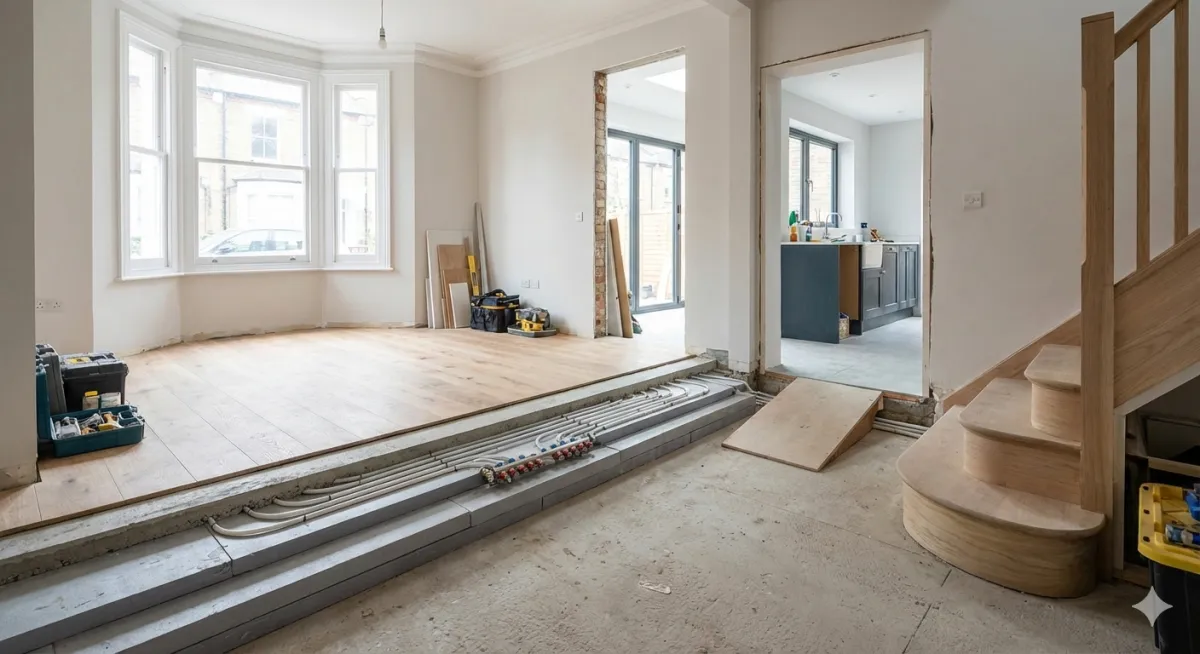
Floor Build-Ups Explained | Renovation Heating Mistakes
“No One Told Us the Floor Build-Ups Would Change Everything”
How small height decisions quietly derail kitchens, doors, stairs and heating performance
Introduction — this is where projects quietly unravel
This usually comes out halfway through a job.
The kitchen is ordered.
Doors are on site.
Stairs are already set.
Then someone asks:
“How thick is the floor build-up… exactly?”
Suddenly:
Thresholds don’t line up
Door heights are wrong
Heating output doesn’t match the room
Costs start climbing
And the frustrating part?
No one feels like they were warned.
What people think floor build-ups are
Most homeowners — and many early-stage projects — assume floors are simple:
“We’re just adding underfloor heating and tiles.”
But floor build-ups are a stack of decisions, not one layer.
A typical build-up can include:
Structural slab or joists
Insulation
Underfloor heating system
Screed or overlay panels
Adhesives
Finished floor covering
Each layer might only be millimetres — but combined, they affect everything.
What actually goes wrong (pulled from real projects)
These aren’t edge cases. They’re the most common complaints seen on renovation forums and reviews.
1. Thresholds and doors stop lining up
A few extra millimetres can mean:
Stepped transitions between rooms
External doors needing alteration
Skirting and architraves no longer sitting correctly
Once doors are fitted, fixing this is expensive and messy.
2. Kitchens and cabinetry don’t land as designed
Kitchen units are designed around finished floor heights.
When floor build-ups change late:
Plinth heights look wrong
Integrated appliances don’t align
Worktop heights shift
This is why so many mid-project kitchen redesigns happen — not because the kitchen was wrong, but because the floor planning came too late.
3. Heating performance is compromised
Underfloor heating output is directly affected by:
Insulation below
System type
Floor covering above
If build-ups are guessed or value-engineered late:
Heat losses increase
Flow temperatures creep up
Rooms struggle to reach temperature
This is where people start blaming the heating — even though the issue is the floor design, not the system.
Why underfloor heating makes this more critical (not less)
Underfloor heating doesn’t forgive poor planning — but it rewards good planning.
Specialist systems, such as those designed by Nu-Heat, are built around precise floor build-ups, not generic assumptions.
Nu-Heat designs systems using:
Room-by-room heat loss calculations
Known insulation values
Specific floor coverings
Change the build-up without redesigning the system, and performance changes.
That’s not a flaw — it’s engineering.
The big mistake: choosing floors before heating is designed
This is the pattern Sable sees repeatedly:
Floor finishes are chosen early (tiles, timber, stone)
Heating is “slotted in” later
The system is forced to work around fixed decisions
At that point, something has to give:
Comfort
Efficiency
Design intent
Budget
Good projects don’t avoid constraints — they sequence them correctly.
How Sable approaches floor build-ups properly
Sable treats floor build-ups as a design decision, not a technical detail.
That means:
Reviewing structural floors early
Understanding height tolerances at doors, stairs and extensions
Coordinating with architects, kitchen designers and joiners
Selecting the right UFH system type for the available depth
This is where different solutions matter.
Example approaches Sable uses:
Low-profile overlay systems where height is tight
Screed systems where structure allows and thermal mass is beneficial
Hybrid approaches when different floors demand different solutions
Every option is checked against heat loss calculations so comfort isn’t sacrificed to save a few millimetres.

Why this matters even more on renovations
Renovations are rarely uniform.
You might have:
Timber floors in one room
Concrete in another
Different ceiling heights
Existing thresholds you can’t move
This is exactly why generic heating kits and guessed build-ups fail.
Nu-Heat’s design process — combined with Sable’s site experience — allows systems to be tailored room by room, not forced into a one-size-fits-all solution.
A simple rule that saves thousands
If your project includes underfloor heating, you should know:
Total floor build-up height
Finished floor level relative to doors and stairs
Insulation strategy
Heating output per room
Before floors are ordered.
Before kitchens are signed off.
That single shift in timing avoids most of the horror stories people wish they’d known earlier.
Next step — sense-check before it’s locked in
If you’re planning a renovation, extension or new build and underfloor heating is involved, a short review now can prevent major compromise later.
Book a floor build-up and heating strategy call with Sable Projects.
You’ll get:
An honest assessment of what’s possible
Clear options where height is tight
Confidence that heating, floors and design will work together — not fight each other

