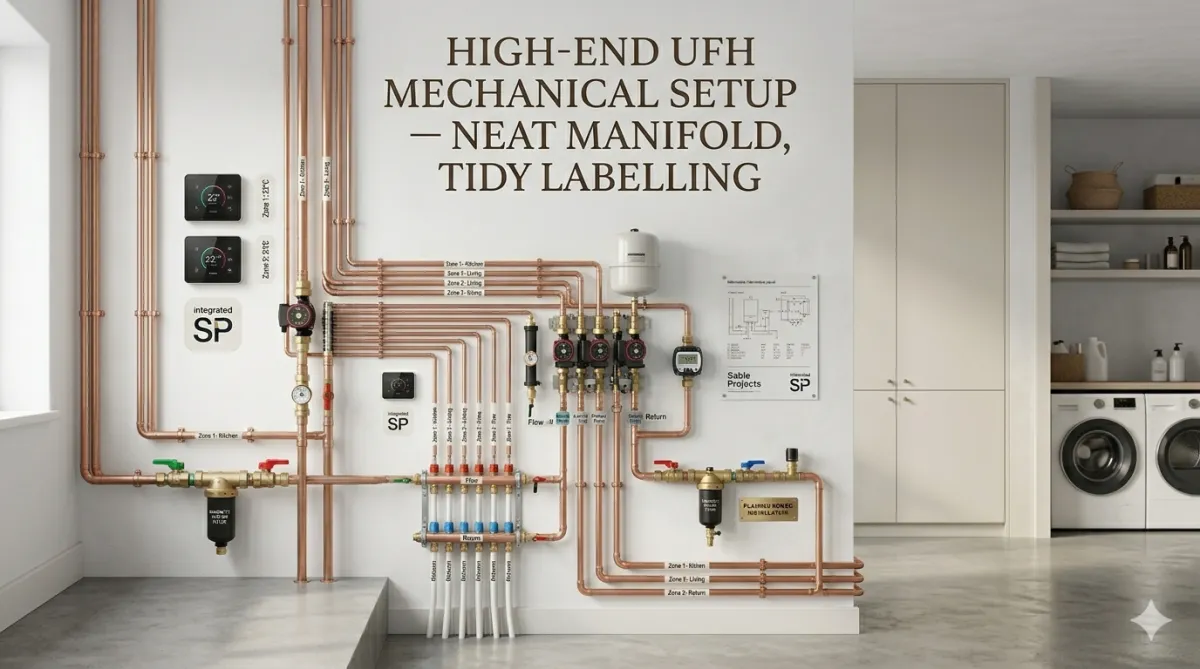
Wet Underfloor Heating Costs in 2026: What a Proper System Really Costs | Sable Projects
Wet underfloor heating has gone from “luxury extra” to a serious, long‑term heating option for extensions, refurbishments and high‑spec homes across London and the Home Counties. But when you start researching underfloor heating costs, you’ll see a huge range of prices — from simple “cost per m²” numbers through to full‑house budgets that vary wildly.
This guide is designed to give you realistic planning ranges for wet underfloor heating costs in 2026, explain what actually drives the cost of a proper water‑based system, and show how to think about budgets if you want it specified and installed once, properly.
Quick overview: realistic wet underfloor heating cost ranges in 2026
Different UK sources quote different figures for wet underfloor heating cost, but most sit in similar bands when you look at full supply‑and‑install prices.
Across 2025–2026 data, a sensible planning view is:
Per m², supply and install (water / wet systems):
New build / straightforward screed floors:often around £70–£120 per m².
Retrofit / refurbishment, especially in existing floors: often around £95–£190 per m², reflecting extra floor work, levelling, insulation and coordination.
Whole‑project ballpark ranges:
Small areas (single room, small extension): commonly around £1,500–£4,000+ depending on size and complexity.
Ground‑floor systems or larger areas in typical homes: often £5,000–£15,000+, depending on m², floor build‑up, and integration with the existing heating system.
Full‑property or high‑spec refurbishment projects can go beyond this, as the “underfloor heating cost” is part of a much larger mechanical and plumbing package.
These numbers are national planning ranges. Sable Projects typically sits toward the upper end because systems are:
Designed around the property and wider heating system.
Integrated with boilers or heat pumps, cylinders and controls.
Installed as part of quality refurbishment or new build projects, often with Nu‑Heat specified systems.
Wet vs electric underfloor heating: why this guide focuses on water systems
Most UK cost guides compare electric underfloor heating costandwet (water‑based) underfloor heating cost.
In simple terms:
Electric UFH is usually cheaper and quicker to install, but significantly more expensive to run over time, and rarely suitable as the main heating system for large areas or whole homes.
Water‑based UFH is more involved and more expensive up front, but generally cheaper to run, particularly when paired with a well‑specified boiler or heat pump, and much better suited to full‑property or large‑area heating.
Because Sable focuses on wet systems designed to perform in real homes and refurbishments — and not on small‑area electric mat jobs — the rest of this guide talks about water‑based underfloor heating costs only.
If you want to see how Sable designs and installs these systems in practice, the main Underfloor Heating page and local pages for North London and Hertfordshire show real project examples.
Typical cost ranges for wet underfloor heating
Using recent UK guides and supplier data, you can think about wet underfloor heating costs in three layers: per m²,per room/zone, andper project.
1. Cost per square metre (supply and install)
For 2025–2026, many UK guides put installed wet underfloor heating roughly in these ranges:
New build, screed floor:
Around £70–£140 per m², depending on system type, materials and design.
Retrofit / older homes:
Often £100–£190+ per m², because floors usually need more preparation, build‑up management, levelling, and coordination with existing structures and floor finishes.
These are broad averages, but they illustrate why simple “£X per m²” quotes can be misleading: two projects with the same floor area can have very different complexities and cost drivers.
2. Typical room or zone‑level budgets
Breaking it down by example spaces:
Small bathroom or WC (5–10 m²):
Wet UFH in small rooms is often part of a wider system; installed costs can easily land in the £1,000–£2,500region when you include manifolds, controls and connection to the main system — even if the area itself is small.
Open‑plan kitchen/dining or family room (20–40 m²):
For a single primary living area, a realistic installed budget is often £3,000–£8,000+, depending on whether it’s new build screed or a tricky retrofit with floor height constraints.
Whole ground floor or large zones (60–120+ m²):
When you start looking at full ground floors or multiple rooms, £8,000–£20,000+is common once manifolds, multiple loops, controls, floor prep, and integration with the boiler or heat pump are included.
Again, the main swing is rarely just the pipe cost — it’s the wider package around it.
3. Whole‑house and refurbishment projects
On full refurbishments, townhouses or larger homes where wet UFH is integrated across multiple floors or with complex zoning, national data shows that ground‑floor retrofit projects alone can easily sit around £10,000–£16,000+, with full‑house schemes going higher.
On these projects, underfloor heating is not a standalone line item — it’s one part of a coordinated heating and plumbing design that also includes:
Boilers or heat pumps.
Cylinders and hot‑water strategy.
Radiators on upper floors.
Controls, zoning and manifolds.
Floor construction and finishes.
This is where the gap between quick, template underfloor heating quotes and properly designed systems becomes most obvious.
The biggest factors that affect wet underfloor heating cost
Every UFH project is different, but most of the price movement comes from these core factors.
1. New build vs retrofit
New build / major refurb with new screeds:
Floors are being built anyway, so UFH can be integrated into the design with minimal extra disruption. This tends to keep per‑m² cost closer to the lower ranges.
Retrofit into existing floors:
Often requires floor buildup, insulation improvements, levelling compounds, door and skirting adjustments, and careful coordination with finished floor levels. This pushes cost into the higher per‑m² ranges and demands more project planning.
2. Floor build‑up and structure
Floor construction has a huge impact on both suitability and cost:
Solid screed floors vs suspended timber floors.
Available height for insulation, pipes and finishes.
Whether low‑profile systems are needed to keep floor levels sensible.
More complex or constrained build‑ups demand more specialist systems and careful detailing, which increases both material and labour costs.
3. Insulation and heat loss
Underfloor heating relies on a well‑insulated structure to perform efficiently.
Poorly insulated floors and fabric can make systems undersized or expensive to run.
Addressing insulation and fabric first can add initial cost but transform performance and running costs over the life of the system.
Many serious UFH cost guides now show running cost comparisons that highlight how wet UFH with a good boiler or heat pump is typically more efficient than electric UFH, and can outperform radiator‑based systems when designed properly.
4. Area size and zoning
More m² naturally increases cost, but zoning and layout are equally important.
Multiple rooms, open‑plan spaces, and varied usage patterns need thoughtful loop layouts and zoning so spaces heat evenly and respond well.
More zones and manifolds mean more valves, controls and design time, which all affect cost.
5. Integration with the wider heating system (boiler or heat pump)
Wet UFH does not live in isolation — it must be designed as part of the whole system:
Boiler or heat pump sizing and flow temperature.
How UFH works alongside radiators or towel rails in other parts of the property.
Cylinder selection and hot water strategy.
Control strategy (room stats, smart systems, weather compensation).
Proper integration adds design time and coordination but is essential for performance and efficiency.
6. Controls and manifolds
Good controls and manifold configurations have a clear cost line, but they are central to comfort and running costs:
Quality manifolds, actuators and mixing sets.
Room‑by‑room or zone‑based thermostats.
Smart or app‑based control where appropriate.
Cutting corners on controls may lower the initial quote but often leads to uneven temperatures and frustrated homeowners.
7. Project context and sequencing
As with boilers, UFH costs are shaped by when and how it’s installed in the project:
Is it being added late, when build‑ups and finishes are already fixed?
Is there clear sequencing with screeders, floor fitters, joiners and other trades?
Are there tight programme pressures or access constraints?
Early planning almost always produces better value and fewer surprises than last‑minute “can we add underfloor heating now?” decisions.
Three real‑world style scenarios (where costs typically land)
These are simplified planning examples based on the ranges above. They’re not quotations, but they show how similar‑sounding projects can land in different cost bands.
Scenario 1: New build or major refurb ground floor
Property: New build or full ground‑floor refurbishment, 70 m² open‑plan kitchen/dining/living.
Floor: New screed floor, insulation and structure being designed now.
Scope:
Wet UFH across the full ground floor.
Manifold and zoning to suit layout.
Integration with a modern boiler or heat pump.
Controls sized and located for future use.
Typical installed range:
At £70–£120 per m², this kind of project commonly lands somewhere around £5,000–£8,500+for the UFH portion, depending on exact system choice, controls and regional labour.
In this scenario, planning UFH from the start keeps costs contained and performance high.
Scenario 2: Retrofit UFH in an existing kitchen and extension
Property: Existing home, 35 m² kitchen/dining area plus 15 m² extension — 50 m² total.
Floor: Mix of existing structure and new extension floor, limited build‑up available in the original part of the house.
Scope:
Wet UFH across the combined space using low‑profile systems where necessary.
Floor prep, levelling and finishing coordination.
Integration with existing boiler and radiators elsewhere.
Updated controls and zoning.
Typical installed range:
At £100–£190+ per m²for retrofit situations, a project like this can realistically land in the £6,000–£10,000+region once all preparation, materials, labour and integration are accounted for.
This is where quick “per‑m²” quotes can be most misleading — the floor and project context drive the number as much as the pipework.
Scenario 3: UFH as part of a full high‑end refurbishment
Property: Larger house or townhouse refurbishment, underfloor heating across key levels, radiators elsewhere.
Floor: Multiple floor types, variable build‑up depths, high‑spec finishes.
Scope:
Detailed UFH design across multiple zones and floors.
Integration with boilers or heat pumps, cylinders and radiators.
Coordination with bathrooms, kitchens and finishes.
Smart, room‑by‑room or zone‑based controls.
Typical installed range:
It’s common for the underfloor heating portion alone to sit significantly above typical single‑room or single‑floor ranges, because you’re effectively designing and installing a full mechanical system, not just “pipes in a floor”.
This is where Sable Projects does a lot of its work: planning UFH as part of the whole heating strategy, not as an afterthought.
Prefer a printable version?
If you’d like to keep or share this with your architect, builder or project team.
Download the Wet Underfloor Heating Cost Guide (PDF)
A printable summary of the cost ranges, scenarios and key questions to ask before committing to a system.
What a “proper” wet underfloor heating quote should include
Given the complexity, a good UFH quote should set out clearly:
Design work:
Heat‑loss considerations and suitability checks.
Floor build‑up, insulation and level management.
Loop layouts, pipe spacing, manifold locations and zoning.
Materials and equipment:
Pipework and fixing systems.
Manifolds, pumps, valves and mixing sets.
Controls (stats, wiring centres, smart controls if specified).
Installation and coordination:
Floor preparation, including any levelling or build‑up work.
Coordination with screeders and floor finish installers.
Connection to the existing or new boiler/heat pump and wider system.
Commissioning and handover:
System testing and balancing.
Documentation and control handover.
If any of these are vague or missing, it’s worth asking more questions before comparing that quote with others.
Why “cheap” underfloor heating can become expensive
As with boiler installations, it’s relatively easy to bring the headline underfloor heating quote down by:
Ignoring floor build‑up and levelling constraints.
Under‑specifying insulation or skipping heat‑loss considerations.
Cutting back on manifolds, controls or zoning.
Treating UFH as an optional extra, not a core part of the heating system.
The problems show up later as:
Areas that don’t heat properly or evenly.
Systems that are expensive to run because they were never matched to the heat source.
Floor height clashes, door issues, or “finished floor” problems.
Frustrated clients who thought they were getting a luxury system and ended up with something that just about works.
Most of the long‑term cost of underfloor heating is decided by design and integration, not just per‑m² material prices.
Where Sable Projects typically sits on underfloor heating cost
Sable Projects is not set up to be the cheapest underfloor heating price on a comparison table — and that’s not the aim.
Most UFH projects Sable undertakes involve:
Proper design around floor build‑ups, insulation and heat‑loss.
Integration with boilers or heat pumps, radiators and hot water.
Coordination with refurbishment or new‑build programmes.
Use of systems from specialist suppliers like Nu‑Heat, specified for the property and backed by robust warranties.
That positions Sable toward the upper part of the typical UK ranges, especially on retrofit and high‑spec projects — but with far more thought, planning and long‑term performance built in.
When wet underfloor heating is worth the investment
Wet UFH is usually worth serious consideration when:
You’re already planning a refurbishment, extension or major floor work.
You want clean lines and more usable wall space than radiators allow.
You’re upgrading to or planning for a heat pump, where low‑temperature emitters are a big advantage.
Comfort, even heat and long‑term efficiency are early priorities, not afterthoughts.
It may be less appropriate if:
The property is not suited to sensible floor build‑ups and insulation improvements.
The budget and programme can’t realistically support the preparation and coordination needed.
Small, isolated areas are being considered where a simpler solution might make more sense.
A good installer should be willing to say “this isn’t the right property or moment for wet UFH” when that’s the honest answer.
How to think about your own project
If you’re considering wet underfloor heating, it helps to:
Clarify your goals:
Are you trying to improve comfort, reduce bills, free up wall space, integrate with a future heat pump, or all of the above?
Look at the project stage:
If you’re pre‑first fix or planning a full refurb, you have far more options than if floors and finishes are already set.
Ask detailed questions rather than just “how much per m²?”
How will floor build‑up and insulation be handled?
How will the system be zoned and controlled?
How will it be integrated with the existing or new heat source?
Compare scope, not just price:
A thorough design and installation that suits your property may cost more up front — but it’s far more likely to perform the way you expect over the long term.
Ready to talk about wet underfloor heating?
If you’re planning an extension, refurbishment or new build and want to understand what wet underfloor heating would realistically cost for your property, Sable can:
Review floor build‑ups, insulation and layouts.
Explain suitable system options and how they’d integrate with boilers or heat pumps.
Provide a clear, written proposal for a system that’s designed to perform, not just to meet a minimum spec.
You can start the conversation from the Underfloor Heating service page or any of the local underfloor heating pages for North London, Hertfordshire, West London or South London — whichever best matches your project location.

